
We spend a lot of time talking about employee engagement. We measure it, survey it, analyse it and develop strategies to improve it.
But perhaps we are starting in the wrong place.
Gallup’s 2026 State of the Global Workplace report contains a statistic that should make leaders sit up and take notice: global manager engagement has fallen from 31% in 2022 to just 22% in 2025. Gallup goes further, concluding that declining manager engagement accounts for most of the recent downturn in employee engagement.
That matters enormously when you consider another longstanding Gallup finding: managers account for around 70% of the variance in team engagement.
Put those two statistics together and there is a fairly compelling argument: if you want to shift engagement across an organisation, your managers may be the most powerful lever you have.
Why is managing people becoming so hard?
The reality is that we are asking a lot of our managers.
They are expected to navigate performance, conduct, mental health, psychosocial safety, changing employee expectations and an increasingly complex employment landscape.
Yet most managers aren’t psychologists, HR professionals or employment lawyers.
Often, they are people who are good operators – good at their job, stepped into leadership, and suddenly found themselves responsible not only for delivering results, but for motivating people, supporting wellbeing, having difficult conversations and managing risk.
And sometimes it can feel like there is no right way to get it right.
We ask managers to drive performance, but also to protect their people. To address poor performance, while being conscious of psychosocial hazards. To have courageous conversations, while knowing those conversations can sometimes result in grievances, bullying allegations or external claims.
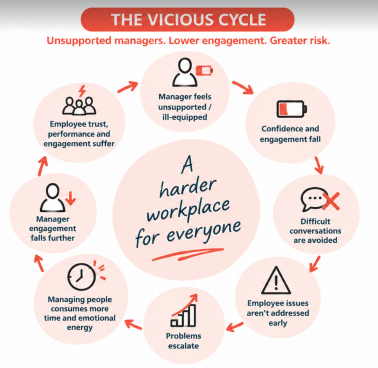
That takes a toll. And it can create a vicious cycle.
An unsupported manager loses confidence. Difficult conversations are avoided. Small issues remain unresolved. Those issues grow. Managing people consumes more time and emotional energy. Trust starts to fall, problems get harder to resolve and the manager becomes even less engaged.
But there is another cycle available.
When organisations invest in their managers – giving them practical skills, confidence and access to specialist support when they need it – managers are more likely to address issues early.
And that is where trust becomes particularly powerful.
Trust makes people easier to lead
PwC’s 2025 Global Workforce Hopes and Fears research found that employees with the highest trust in their direct manager are 72% more motivated than those with the lowest levels of trust.
But trust isn’t only valuable because it makes employees feel good.
Trust changes the amount of energy it takes to manage people.
When there is trust, an employee is more likely to approach their manager while an issue is still small:
“Something happened yesterday and it’s bothering me. Can we talk about it?”
Blanchard’s ‘Conversational Capacity’ teaches us that a capable manager can bring both curiosity and candour to the conversation – asking questions to genuinely understand where the employee is coming from, while also having the courage to contribute an honest and constructive perspective.
Sometimes that means helping an employee consider what they might be contributing to the situation.
That five or ten-minute conversation can prevent weeks of frustration, conflict, meetings, correspondence or formal processes later.
And every time a manager handles one of those conversations well, they are building more trust for the next one.
That creates the opposite cycle: confidence increases, conversations happen earlier, trust grows, problems stay manageable and leadership becomes less draining and more rewarding.
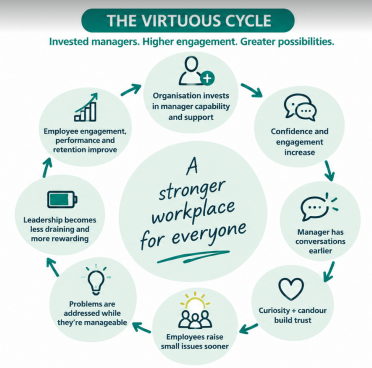
We see the impact when organisations genuinely invest in their managers. Managers become more confident and engaged, performance improves and organisations tell us they see meaningful improvements in retention and the way their teams work together.
So perhaps when employee engagement starts falling, the first question shouldn’t be: “What do we need to do to engage our employees?”
Perhaps we should first ask: “What are we doing to engage, equip and support the managers responsible for leading them?”
Because investing in your managers isn’t an investment in a small subset of your workforce. It’s an investment in the experience of everyone they lead.
Invest in your managers. Impact your whole organisation.
At Focus HR, we work with organisations to develop practical leadership programs tailored to their managers, their workplace and the challenges they are actually facing.
If you’d like to explore what leadership development could look like in your organisation, reach out to the Focus HR team. We’d love to start the conversation.